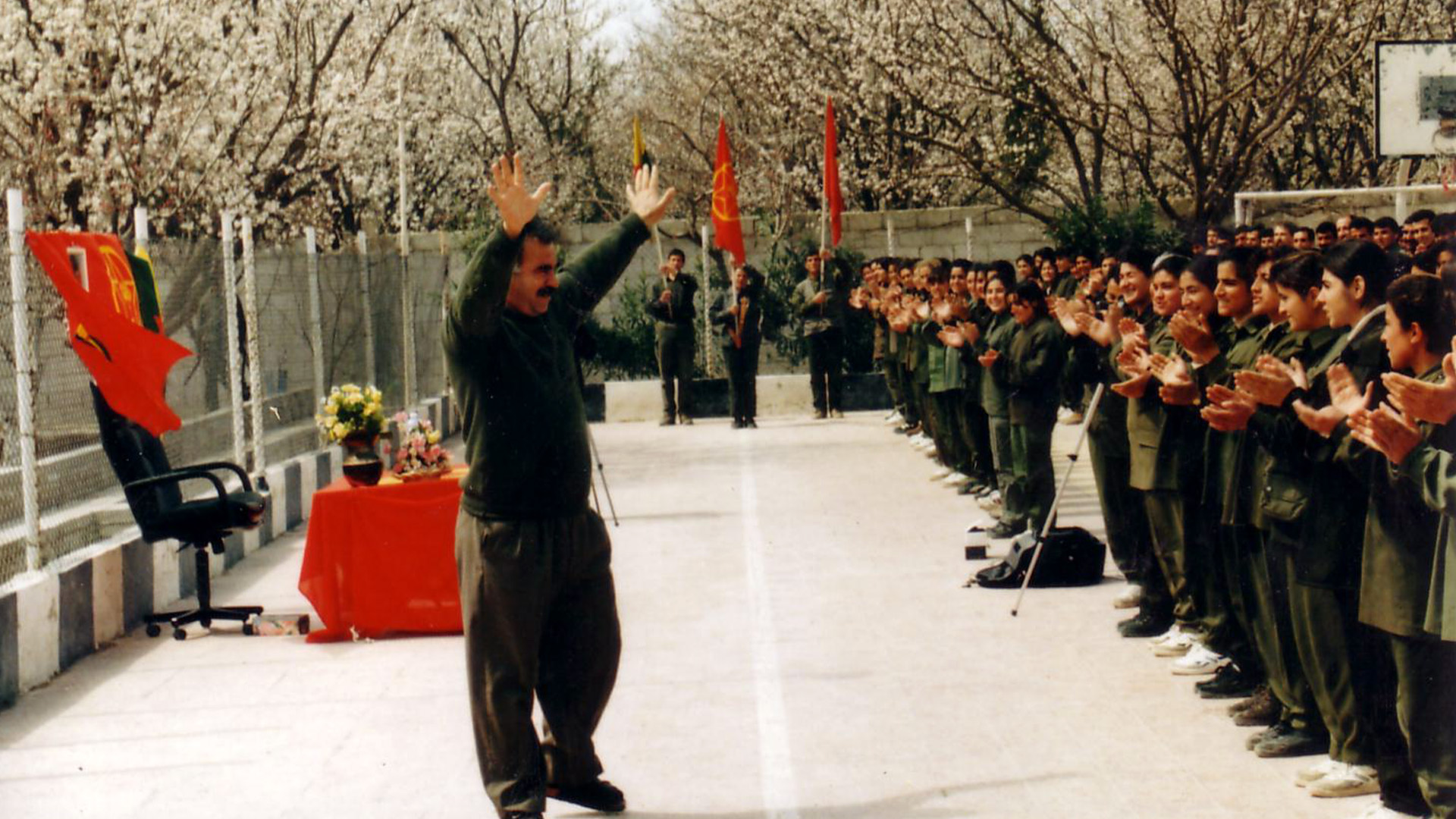
Yes, I say a wish, because I had always wanted to cross into the field of war. At that time too, I was always proposing that I go to the mountains. But this wish of mine was not accepted then.
The reason was that some comrades did not consider it suitable. Whenever I saw the Leadership, I would make my request to go to the mountains. But the Leadership would not accept it, because it said: "At that time, many comrades fell as martyrs in the Rojava region. You should gain experience here for now; later you can go to the country." This wish of mine was always warm, and it lived with me. It adorned my dreams at all times.
It was 1994, the eighth month. We were in a training program. There were women comrades in the training as well. This training was being conducted in Aleppo, and I was responsible for the women comrades. At that time the conference of all areas was being held. The conference had been organized at the organizational level of Aleppo, Afrin, Kobani, and Latakia. We took part in the conference. When the conference ended, we moved into training together with all the comrades, so that on this basis we could convey the conference report.
One day, while the conference was still continuing, the comrades had left us a note. I needed to get myself quickly to a house. It belonged to a patriotic family, and they had given a time as well. We still had not clarified why we were going to the place we had been told about. We guessed that the training report would certainly be given. Every fifteen days, we gave our report to the training officer. When the reports of the school officers came together, they were evaluated. That was how I understood it. Our Aleppo officer was comrade Ozgur. Comrade Ozgur was a Laz comrade. He had left us a note. With this comrade we went to a patriotic family's house. Comrade Leyla was waiting for us. Her first words were: "Comrade Arşem, have you come?" I answered: yes, comrade, I have come; I have been waiting for you for a while, there is report training. She said: I do not know, but the comrades will take us somewhere. When she said they would take us somewhere, I realized that something was going on. Why would they take us somewhere? We already tell each other everything. But it seemed clear that wherever we were going, the Leadership would also be there then. This was being done so that the Leadership would not be exposed. I understood and said: then the Leadership has come to Aleppo; we will see it. Comrade Leyla said: I do not know...
We got up and waited there; a car came, picked us up, and took us away. But we kept asking where we were going. Of course, it was natural that we were not told anything. Our conversation in the car went on, continuing with great excitement, and this lasted until we reached a house. Comrade Ozgur was waiting for us in this house. When we reached the house, comrade Ozgur was standing outside by the door, waiting for us. In an irritated way he said to us, "Why were you so late?" We said: comrade, we did not know; we had not been told. We went inside. All at once, we saw the Leadership before us. Under normal circumstances, comrades always prepare themselves first, and then the Leadership comes and holds a meeting with them; or when a period ends, then they give their pledge to the Leadership. But this time the comrades had not been prepared, and the Leadership was standing there waiting for us. Naturally, whether one wants it or not, a great excitement seizes a person. How could such excitement not come! The Leadership standing and waiting for you. The Leadership looked at us and said, "A person who is a soldier comes on time; why were you late?" We looked at one another and answered, "My Leader, at first we did not know the note that had been given to us; we had prepared ourselves for six o'clock." The Leadership said: all right, all right, come and sit. What are you doing?
We were six women comrades: comrade Leyla, Rewşen, Zozan, Dîcle, Cahîde, and me. We sat down. Three of us were area officers. There was silence. These questions were passing through our minds: how had it happened that we had all been brought together? We did not know why the Leadership was holding a meeting with us. The Leadership looked at all of us and began to speak: what are you thinking, what do you guess? Comrade Ozgur was standing on his feet and said: my Leader, we have not said anything yet. The Leadership said: of course, of course, everything of mine is a surprise!
All six of us looked at one another, wondering what surprise the Leadership had prepared for us. At first it said to me: stand up, are you ready to cross into the country? I stood up. I did not know how to answer. Because before, I had insisted many times that I cross into the country, and it had not been accepted. How was it that within a month and a half the Leadership itself was once again saying, are you ready to cross into the country? I stood there like that. I froze. I could not answer the Leadership. The Leadership said to me: what do you say, are you not ready? From excitement I could not speak and could not give the Leadership a clear answer.
In great excitement I answered the Leadership: "Yes, yes! My Leader, I am ready to cross into the country." At this the Leadership said: "Speak properly; why has your tongue gone mute?" I said, I do not know, and sat down. Then it looked at the other comrades, and the comrades all said together: we are ready to cross into the country. All had come for a report, but the greatest surprise for us was suddenly seeing the Leadership. All six of us looked at one another. Was it a dream, or was it reality? For us, reality was moving back and forth between dream and fulfillment. We ourselves were astonished that such a decision had emerged. The Leadership said: all right, perhaps now you are saying it is a dream; but come out of this dream, you are going directly to the country.
Again we looked at one another, because we still could not believe it. The Leadership smiled and said: "All right, now let me tell you about your going to the country: last night comrade Ebas, comrade Karasû, and comrade Şervîn left Damascus and crossed to Qamişlo. They will go for the Fifth Congress. We wanted to send a group from Aleppo as well. In particular, the women comrades must go, so that they are ready for the discussions of YAJK and for the work of women. We want to transfer you into the country. The thinking you have developed here, you will convey to the congress. You can be present at the Fifth Congress. Reach there and be ready. On this basis you are crossing into the country. What do you say, what is your view? Now we will begin; what will your role be? Your crossing is a historic crossing. Because after the Fourth Congress, the Fifth Congress is being built. On this basis we must once again pass our flag before our eyes, and with it create changes in the field of mentality. As women comrades, you are going from the field of the Leadership. Politically, you must convey to the congress the things here and the analyses you have made. This is one important side of your significance. Another significance is that, after the militarization of women, for the first time women must make a decision by their own will and hold their own congress. Women must organize themselves in the mountains. This is very important. It is also very important and necessary for you. Be conscious of this. You are going from the field of the Leadership; the analyses you have made, the practice you have seen, you know the suffering of the people, you know the suffering of women. If this is not taken up within the field of organization, we cannot solve the problem of women, and this still preserves its importance. For that reason I say to you: your going is a historic going. You must be aware of this. Our comrades have remained in war for years. They are distant from women's autonomy. There are no opportunities for education. Each of you will enter among the women comrades and be able to bring about transformations. This role falls on your shoulders. In this way you will go there and fulfill your role both through your participation in the Fifth Congress and through your participation in the founding of YAJK. This role and task are very important, and their responsibility is heavy. You must cross in this way, with this spirit."
As the Leadership spoke, little by little we came out of dreams and felt ourselves in the field of war; we came under the weight of our duty. In this way it was engraved in our minds. It was now in our heads. The dream of how we would play this role in the field of war was, for us six women comrades, truly a very heavy excitement in relation to the responsibility the Leadership had placed on our shoulders. In this way the Leadership spoke with us for three hours. The most striking part of the talk was our historic role and our entry into the country.
Then the Leadership said: all right, sit down, bring cola and cake for the comrades. Each of us drank a glass of cola. But the Leadership insisted that we drink another glass as well. On this basis, it stood up itself, brought us cake, placed it before us, and insisted that we eat. We felt greatly encouraged. As the Leadership itself cut the cake into pieces, it said to us: "You must eat; perhaps this will be my last meeting with you." This gave us tremendous emotional encouragement. Because we would be moving away from the Leadership, and this created deep feelings in us.
Whenever the Leadership saw me, it would say: "You are very heavy, but despite your weight you are very light and active. When you go to the country, what will you do? The comrades will say: this heavy comrade will become a burden on us. But I am sure that if the comrades get to know you, they will not think that way." To comrade Rewşen it said: "Your walk is like the walk of village girls. If you go to the country, you will be accepted quickly, because you walk like a village girl. Our comrades in the mountains walk in this way. A group has come from the mountains; it is exactly their movement. Therefore you must change your walk and build a military walk in yourself." To me it said: "You must become very thin; when you go, your aesthetics will also become more beautiful."
The turn for giving the pledge had come, but we were not aware of it. All six of us looked at one another.
Comrade Leyla said: my Leader, I have prepared the text. I said: I am ready to give the pledge for you and the martyrs. We gave the pledge together. But during the oath, comrade Leyla, because of excitement, could not complete the pledge toward the end. The Leadership itself repeated the pledge with us and we completed it. When the Leadership finished, we forgot to applaud. In response, the Leadership said: "What has happened to you, why are you so excited? Do not do this. If you go like this, you will lose quickly. From this hour on, you are guerrillas, and a guerrilla is a soldier and does not fall into excitement." Then the Leadership called comrade Rewşen, and she went and stood beside the Leadership. The Leadership told comrade Rewşen: you must not stand bent like that; stand beside me like a soldier.
My turn had come. Because it was cold, I had put on my parka. It said: Arşem, come, you are heavy and I am heavy too, let us see what we will do. I said: my Leader, I do not know. It said: "I will make myself thin." I said: my Leader, because it is cold, we have put on parkas, and this also makes us look a little heavier. The Leadership said: all right, take care of yourselves and of your eating, and we took a photograph together. Then it said: comrade Leyla, come beside me. Comrade Leyla was very short, and she bent down to put her hand on the Leadership's shoulders, but her hand did not reach the Leadership's shoulders. At this, the Leadership said: my suggestion is that you bring a chair and stand on it beside me, or else we sit together on a chair. Comrade Leyla said: my Leader, however you like, let us take it that way.
The Leadership said: "Tonight you will set out. You will go to Qamişlo, and in Qamişlo you will see comrade Ebas and comrade Karasû, and with them you will cross into the country. Do not stop in Qamişlo. On this basis, make your preparations." I also said: all right!
Then it asked: do you want to say anything? We said: no, my Leader. The Leadership said: no, no, you have not made your preparations for the country. Go to Qamişlo, let the comrades write a note, and let them buy some things for you. I will write a note with my own hand; go to the country and give it to comrade Cemal.
We said farewell to one another and embraced one by one. When the turn came for me and comrade Leyla to embrace, the Leadership said: you are heavy, but firm and light. It also said to me: in order to lift a weapon, you must make yourself thinner. I said: all right, my Leader. I promise, when I go to the country, I will make myself thinner. The Leadership said: look, you must know your own value well. Let me say something: what is there here? Every person paints a dream in their mind; how that dream becomes reality, how a person lives with these dreams, and how it is expressed in that reality.
The important point for me was this: whenever a comrade came from the country, I would say that I wanted to ask what the situation of the country was like. In that process, many comrades were crossing to Rojava and many were also falling as martyrs. An anger of revenge was branching out inside me, and I was saying: how can I reach the country and take revenge for them?
On this basis, it was like a dream in my mind; night and day I lived with my dream. On the last day, when we said farewell to the Leader, it said: your going to the country is a historic going. It placed that responsibility on our shoulders. This was a very important responsibility and carried a very great meaning. For me, the conscientious and moral side was how we could prove worthy of this responsibility.
The weight of this responsibility always passes before my eyes in my practice and action, and every day I call myself to account. With the trust the Leadership gave me, I still walk on the strength I received from it. And I turned my dreams into reality.