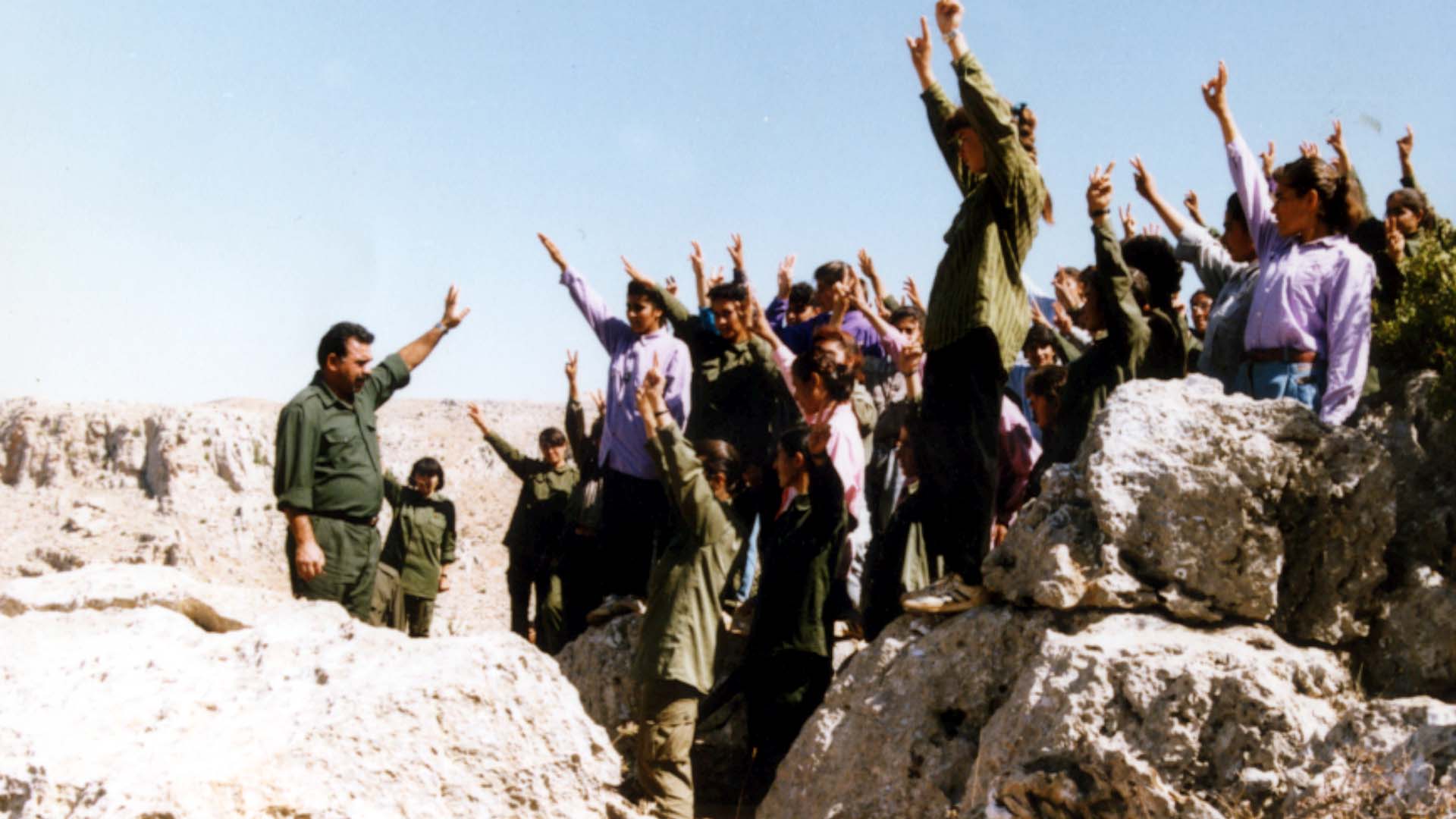
I have tried to present a concise account of the essentials of the PKK’s history. Some assessments can teach us a great deal.
I have used this formulation before: “What is being analysed is history rather than the moment, society rather than the individual.” Its meaning will become clearer when we apply it to the PKK. Through the PKK both Kurdish history and Kurdish society came under analysis. That is true of its positive and negative aspects alike. We need only read it correctly and draw sound lessons.
I have never doubted that becoming the PKK was a contemporary birth for the Kurds, a Kurdish rising. Yet I had never imagined that individuals described as Kurds could be so contradictory, futile and weak on one side, and so upright and daring, self-sacrificing and brave on the other. I analysed personality a great deal, yet I still cannot say I have reached and understood the Kurd. The Kurd has been driven so far from himself. However Kurdish he may look in form, in essence he has become someone else. He is not even aware of the bounds of his own betrayal. Neither the laws of humans nor those of animals apply to him. It is as though he belonged to a third kind of creature.
The fundamental role I wanted to play in the formation of the PKK was plainly in the realm of thought. Yet the existing theories could not account for me as an individual or for the Kurds and Kurdish society from which I came. However hard I tried, I could not free myself of shortcomings and errors. As early as our initiative in 1975, together with M. Xeyrî Dûrmûş, I began setting out the ideas of a draft on imperialism and colonialism in a call in the manner of Zarathustra. I think that draft is still available. It has lost none of its importance and stands as it did. It could still be used as it is. It was a good draft, made up of ideas that had left their mark on the revolutionary thinking of the time. It could make a substantial contribution to the intellectual struggle of the Revolutionaries of Kurdistan. My tours within the framework of that draft were noteworthy. I began with my speech at a meeting of the Chamber of Architects in Ankara in March 1976. I then continued my tour through Agirî, Bazîd, Qers-Dîgor, Dêrsim, Çewlik, Elezîz, Amed, Ûrfa and Dîlok and ended it back in Ankara in May. My tour ended on 15 May. In response to it, on 18 May Hakî Karer was killed and fell as a martyr at the hands of a suspect group called Stêrka Sor, in a plot by Alaattîn Kapan. The martyrdom of Hakî Karer came upon us like cold water poured over our heads. It was an event that changed the course of history. The suspect group may have had links with the PDK, with remnants of some Turkish groups and with some groups acting in the name of the state. Our intellectual struggle therefore turned very quickly towards a tangled set of targets. It very soon ran the risk of becoming an instrument of physical warfare.
This was the time of the May Day workers’ rally in Istanbul, where 37 citizens were killed in a plot, and of the assassination attempt against Bulend Ecewît. At the time an ominous prospect of civil war was visible in Turkey. Under those conditions, we decided that the group should rapidly form a party. As a task and a duty of loyalty to the memory of Hakî Karer, I prepared the draft programme in Dîlok in the autumn of the same year. I returned once more to Ankara, and from there, with that strange marriage, I flew to Amed at the beginning of the summer of 1978. It is more accurate to see this marriage as a great intellectual, political and emotional struggle. Kesîre’s Alevi, Kurdish and statist personality heated and complicated the intellectual struggle I had entered. When she entered the group as a woman, a step had to be taken with her and she had to be brought along. She was like deep, still water. The further I went into it, the more I felt its suffocating effect. There were two things I could do: either distance myself from her entirely, or try to overcome that suffocating influence. Removing her from the group would have been an easy way out and would have meant backing down and surrendering. On the one hand I proposed marriage to her for the good of the group. On the other, I truly felt it was necessary for the essential reckoning to take place with me. Clearly, it was a political, emotional and intellectual relationship. It would have been very good if she had turned out to be a socialist. There was also a possibility she might turn out to be a state operative, in which case it would be a battle of minds and we would see who made use of whom. In this matter I was sure of myself, within limits. Yet my pride and dignity did not allow me to count a Kurdish woman as belonging to the state, even as a matter of form. Even if she had been, I could have waged a struggle with the state over a woman. Perhaps that struggle would not have drawn both sides into a bitter war and might have led them to agreement and peace. I had some intuitions of this kind.
Because of my Sunni tradition I did not take the issue of Alevism very seriously either, and regarded it as one of the factors that inflamed and provoked the situation. I thought that in this way I could help bring Sunni and Alevi Kurds together. During the Dêrsim uprising her family had taken its place in the Kemalist ranks and still followed that social-democratic CHP tradition. I saw this too as an opportunity. Social democracy could have been a door opening onto peace and agreement. Later it would become clear that just as the CHP’s social democracy was a polish on the state, Kesîre’s social democracy and leftism gave a polish of the same character. Over this great ten-year intellectual struggle, no agreement was reached with the woman’s Kurdishness, Alevism and left-wing statism. I did not approve of the organization’s position that she should be killed. Strangely, she was abducted with the help of Greek intelligence, the same intelligence service that played a disgraceful part in my abduction. She did not appear again after that incident in 1987.
Some contemptible people inside and outside the organization did me great wrong on account of this relationship and spread suspicion and malicious rumours about me. The truth is that this relationship demanded extraordinary patience and effort in my life. Perhaps for the free Kurdish person, and especially for the emergence of the free woman, it was a great intellectual struggle, a struggle for freedom, patriotism and love.
The newspaper Serxwebûn, whose publication had been planned, circulated the manifesto as its first issue. Looking back at the manifesto, we see that it was the culmination of the meetings of 1973, the directives of 1975 and the speeches of 1977, their most coherent formulation. It plainly recalls the Communist Manifesto. Its content shows that it seeks to address the Kurdish people and all the societies of the Middle East. Its content and style are closer to social freedom than to nationalism. A national identity without freedom is unacceptable, and freedom without a national character is inconceivable. The impetus from the manifesto made it imperative to form a party. Only a few technical questions remained, such as the name and who would start it, and they were not all that important.
The work on ideas that we began in the early 1980s moved somewhat closer to analysing the relations between politics and force. The talks on The Role of Force in Kurdistan, the National Liberation Front, On Organization and The Problem of Personality stood out as efforts at analysis. They drew on experiences in Israel and Palestine and the Middle East. Years of intellectual work had barely awakened a limited section of the youth. Once steps were taken in the military and political sphere, society as a whole was shaken to its foundations. A real party formation could prove its maturity through these steps. Otherwise it would die as if of a childhood illness. Once prison resistance and the work in the Middle East came together, the guerrilla initiative imposed itself. No negative step could stop it. The state meanwhile continued its all-out denial and repression. The two realities were in a position of complete mutual non-recognition, each refusing to accept the other. It was pointless to look for common ground. The striking attitudes of Kesîre and the lawyer Huseyîn Yildirim at the time later made me wonder whether they had any links to the state. Yet it was difficult to find even a small piece of evidence that would point to this. Such an effort itself required courage. Later the attitudes of Mehmed Şener and Selîm Çurukkaya raised the same doubts in me. Yet despite those attitudes, their strength did not go beyond that of ordinary agents. I therefore did not intend to take them very seriously.
While the first initiative to build a party was still at the intellectual stage, Kesîre, Şahîn Donmez and others like them tried to render it ineffective. The second initiative was floundering as if about to die in the grip of gang formation. Every initiative conceived to end the situation struck the hard walls of the entrenched gangs and melted away. Neither our shortcomings as a leadership nor the attacks of collaborators and the state opened the way for this. The realistic assessment is that the impact of gang formation was underestimated and the corresponding measures were not taken. Victory belonged to the gangs, not to the leadership or the state. The position of the guards with the state (village guards paid by the state), and of the gang leaders, most of whom were informers, explains this well. The state clung to this weapon for too long, and then its boomerang effect became apparent. The boomerang was now coming back at it. This would become clearer in the years ahead. Just as the leading tribal gangs in southern Kurdistan appeared before them as a federated state in the early 1990s, in the north the leaders of collaborators, village guards and religious orders emerged as a political and even military weight confronting the state. They could no longer be dealt with easily.
The traditional tribal leadership in southern Kurdistan ventured on the greatest betrayal at the most sensitive point in Turkey’s war with the PKK, in exchange for its important interests. Compared with betrayal in the prisons and in the war, this one was carried out more cunningly, more systematically and more covertly, encouraging Turkey to lean still further on gang policies. The forms of Turkey’s political structures were already suited to gang formation. When the army’s predicament was added to this, the road leading to today’s federated Kurdish state opened. The Turkish leadership certainly did not expect this outcome. It regarded the relationship as tactical and believed it would end with the liquidation of the PKK. It was also unaware of the true scope of US policy on Iraq. The collaborationist Kurdish leadership was more aware and deliberate in its aims. It pursued these skilfully in its relations with both KT and the PKK. In practice, it was the commanders of KT and the PKK who acted lightly and superficially. A comprehensive assessment of this period would bring many facts to light. It is particularly important to clarify, within the Turkish state, the tensions and relations between the concept of a gang state and that of a classical state. It is necessary to know which politicians and institutions caused real harm, not only to the PKK but also within the state. It is also necessary to understand how those who broke with the revolutionary principles of the republic moved towards another state structure in the name of a Turkish-Islamic synthesis, what role the war in Kurdistan played in this, and how they opposed the republic through Kurdish tribalism, the village guard system and feudal religious orders, paving the way for developments such as the federated Kurdish state.
To understand how this stage was reached, it is important to see the part played by international events. Without them, developments within the PKK and KT cannot explain the situation. The disintegration of the Soviet Union in 1990, Clinton’s leadership and globalism all had direct or indirect effects on the Middle East, Turkey and Kurdistan. The Soviet collapse weakened Syria’s resolve and opened the way for the well-known departure. Diplomatic support weakened. It was deprived of potentially broad support. The pressure for change that globalism puts on the Middle East forces us to look ahead. Otherwise, we will be unable to foresee the course of events in many countries, above all Iraq. Clinging to the old paradigm would mean failing to see what lay ahead and being led into conservatism. It should also have been foreseen that Clinton’s arrival would bring different tactics towards the region. Had US policy in the region, Turkey and Kurdistan been understood in depth, perhaps the situation after the departure from Syria would not have arisen. Superficial and belated assessments cause one to fail to act in time and let the initiative slip away.
The failure to make theoretical and paradigmatic changes in time helped bring about the present impasse. Developments on the left, cultural movements, feminism and ecological initiatives in the quarter of the twentieth century were not followed closely. Nor was the importance of civil society and the struggle for human rights understood in sufficient depth. The PKK’s tactics, strategy, organization and programme were very heavily influenced by the schools of national liberation and actually existing socialism. The changes made at congresses therefore went no further than tactics. The basic paradigms of the worldview did not change. Although detailed analyses were made, the absence of a basic paradigm prevented changes at the root. The approach to social developments was still schematic. A dogmatic mentality affected the way nature and society were seen. The mentality of the Middle Ages had been left behind, yet the schematism of actually existing socialism did not open the way to a productive theory in its approach to society and nature. A formulaic attitude to change and transformation drew a curtain across the rich world of events. More importantly, an excessively military and political personality could see only one side. Hierarchy was imposed on relationships. The disease of power spread rapidly like an epidemic. Revolution was for the freedom and equality of peoples, and democratization was an essential stage in that process, yet it remained secondary. A military-political attitude had become decisive in all relations. Such conduct may have meaning in military circumstances, but when imposed on an entire people it becomes one of the fundamental maladies of actually existing socialism.
There was also no interest in new theoretical approaches or in changing the paradigm. Perhaps there was a fear that the views and their consequences might turn out to be wrong. But the Soviet collapse made it imperative to reassess socialism. Though interest in the environment and the question of women had grown, the necessary theoretical depth was limited. A better approach to ethnicity and a break with narrow class-based and economistic schools could have opened the way to a rich democratic and communal perspective. Although relevant interests had emerged over time, they lacked the depth to end the impasse. The truth is that the PKK arrived at the threshold of the year 2000 still relying on the paradigm of 1970. Though the party had not disintegrated completely, it had largely lost its function.
Not everything in these developments is to be assessed negatively. The history of the PKK was at the same time the history of the Kurds and Kurdistan, and the history of great changes and transformations in their society. One can say that Kurdistan bore the imprint of the PKK in the last quarter of the twentieth century. The changes it brought about in thought and the upheavals it caused became part of history.
Despite all the great destruction, its organizational existence largely continues. There is organizational potential inside the country and abroad, in all parts of Kurdistan, and there are foundations, logistics, resources, cadres and many civilian groups, institutions and bodies for it. Abroad and in neighbouring metropolitan centres, there are millions of sympathizers among the people. There is considerable organization and awareness among women. It is as if a new world were rising and being built around them. Women’s freedom constitutes the fundamental elements of the new paradigmatic approach and theory. The situation of young people is much the same. The youth have lost none of their interest or ardour and remain determined followers of the ideal of a free society. They must never let go of the slogan “Either a free life or nothing”, holding it like a flag. The party formation has not collapsed entirely. With its great experience, its thousands of cadres, tens of thousands of sympathizers and hundreds of thousands of followers, it can readily rebuild itself if it finds the right form and substance. The guerrilla forces remain present with thousands of people in central Kurdistan and at all strategic bases. Once it has rid itself of its grave former maladies, it will be more ready than ever, with its considerable accumulated experience and a sounder political programme aimed at victory. Despite the encirclement it faces, the PKK maintains its bases of friendship and its network of relations in every corner of the world. Thousands of heroic martyrs of the PKK await their comrades, who must represent them in sound thought and practice.
In brief, one can say that one never regrets the effort and work made for freedom. Pain and grief have always been good teachers to those who know their worth. This time too, through labour and by right, lessons in goodness, truth and beauty would be learned from the finest teacher.
Party Leadership