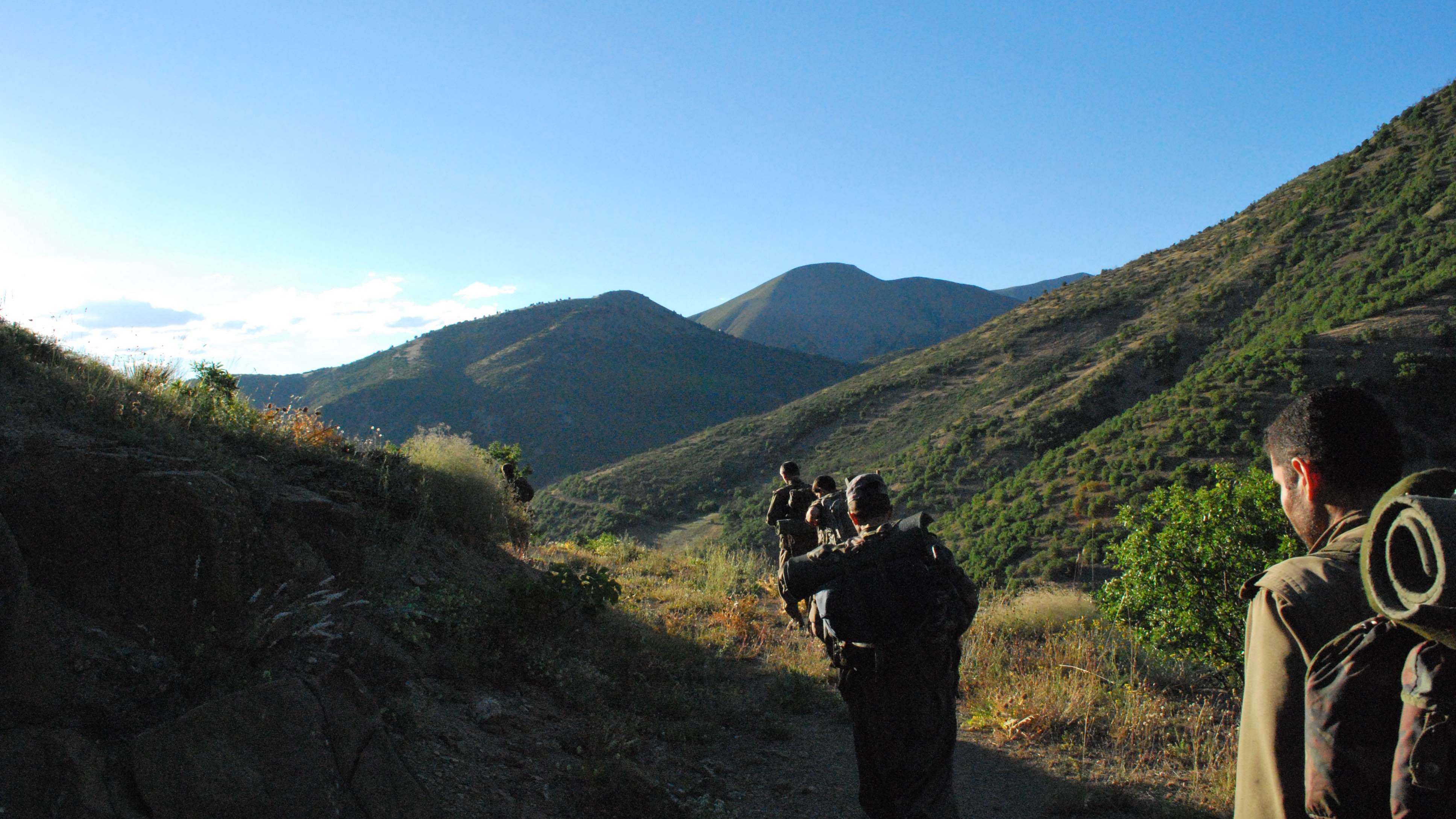
Herekol makes a person swallow his tongue, makes him forget what he knows. Sometimes a person becomes unable to think.
Perhaps familiar thinking ceases to be a need. Body and spirit, human being and nature, pass into one another. Thoughts are extremely faint, yet if they show themselves they brighten. It is as if every cell of the human being comes to speech. At the same time it is as if everything is speaking with you. Familiar words grow smaller and smaller, and one feels like saying, if only I could swallow my great tongue too. Words are constructed; words are absent in dry eyes; words of mercy have become traps, every kind of evil has come and settled, hidden inside words. In most sweet tongues a killer is hidden. The sweet tongue has been designed mostly to kill. For this reason, the bad tongue is the one that runs to the work of keeping alive. Perhaps the saying “a friend speaks bitterly” was said for this reason. For this reason, preferring hemlock to sweet words may perhaps be more vital. Love has become the strongest instrument of killing. ‘Love has become killing,’ how strange!
You fall silent, you do not say a single word; I know it is not from not knowing. It is so that words will not be debased. You speak your silence with your pride, with your honor. Your looks speak. Your silence speaks. You are rebellious, you do not know submission, you have no lie, your inner self laughs, you overflow, you add hope even to your sobs; even if you are forgotten, you remember, you commemorate, you defeat only yourself, is that not enough?
It is said that Sait Bey rises up in Dêrgulê against the Ottomans. He does not want to send soldiers or pay taxes. Kurdish beys and mirs, who had alliances with the Ottomans for centuries, live in an autonomous position. They are the Ottomans' most loyal, most trusted friends. From Malazgirt, when the gates of Anatolia were opened to the Turks, to these days they helped, prevented the loss of many wars, and became the means for winning many strategic wars.
When the Ottoman could no longer expand and began losing the wars it entered and emptying its treasury, it turned the resentment of its defeat, helplessness, and degradation ‘inward.’ By burdening the Kurds and wanting to take heavy taxes and large numbers of soldiers, it tried to escape this psychology. The Ottoman had long since begun eating itself.
Previously, aghas, beys, and mirs who ruled in their own harems, that is, regions, had the possibility of arranging their internal affairs on their own initiative. While they sent a small sum of the taxes they collected to the central Ottoman state, they could use the remainder as they wished. They also had initiative in gathering soldiers. They could send a ‘reasonable’ number of soldiers for the Ottomans. Although at times these ‘reasonable’ numbers rose to astronomical levels and lost their reasonableness, it was managed. But when the Ottoman state, for known and unknown reasons, wanted to push aghas, beys, and mirs aside and leave nothing in hand, history evolved into a new process. In Kurdish-Turkish relations, the essential thing now is revolt. Since the Kurdish ruling classes, as much as the Kurdish people, were harmed by these heedless Ottoman policies, one could rebel without even needing to think. And indeed the Kurdish revolts of this period seem not to have received much of a share of thought. Questions such as against whom, in whose name, and how were not asked much; they showed a fragmented feature, lacking a complete and integrated perspective and plan, flaring suddenly and dying out, consuming themselves.
Now let us look at Sait Bey's revolt. Without power, without alliance and organization, deprived of strategy and plan, with arms and military structuring at the level of ‘nonexistent,’ revolt is made against the Ottomans. Even Bedirxan Bey, Kurdistan's strongest and most effective mir, does not stand with him. He becomes one with the Ottomans and turns Dêrgulê into hell. Sait Bey surrenders, and the people are put to the sword.
What I am trying to explain here is not that the Kurds were not right in these revolts. The problem is in the form of attempting rebellion. It is an attempt at rebellion condemned to absolute defeat. Agit-ness among Kurds is similar to this. There is no surrender in Agit-ness. There is resistance to the end and death. But when the overwhelming majority of our revolts of this period are examined, from the smallest to the most comprehensive, the final point is surrender. To “resist well and surrender badly” is not good.
Dêrgulê, whose people were formerly Êzidi and later became Muslim, always suffered. They paid heavy prices. They suffered betrayals so repeatedly that a time came when they themselves fed traitors. They tolerated the “baseness” that caused the blood of their own guerrillas, their own fighters, their very own sons and daughters to be shed. Does this suit you at all!
With the emergence of our Freedom Movement, the process Dêrgulê experienced is very interesting, very contradictory, and very striking. I think I will open up some aspects of it in the future. If I had the opportunity, I would like to write a book that researches and evaluates Dêrgulê's history, geography, culture, all kinds of stories and events, down to its people. Would it be bad if countless young women and men, instead of wasting their lives idly, turned toward such acts of consciousness and creation?
Of course, we can say and do this for every city of ours, every town and village, every tribe and region, every valley, water, and mountain. We are hopeful, because the Kurds and Kurdistan are coming alive again. Mesopotamia is waking. Kurds are waking; Assyrians, Armenians, Turkmens are waking. In short, all the peoples of the Middle East are waking. Even if they are in the dizziness of a five-thousand-year sleep, this is an awakening. It is slow, but just as deep. We are returning from fantasies and dreams to reality. Memories are coming alive again, voices are becoming suited to poetry, klam, and matchless melodies. Frozen hearts are thawing. The light of your eyes is more nourishing than the sun. We are reviving our sacred ones and becoming whole with them. Women, the women of Kurdistan, are again in the forefront. Nature, our nature, our dying mother, renews herself. We are renewing ourselves, I am renewing myself.
This is such a march that no force is capable of stopping it. No dark effort can succeed in this. Neither clubs, nor timbers, nor gas bombs, nor armored vehicles, nor tanks, nor cannons, nor cauldrons, neither special nor very special armies. Neither political genocide plans, nor policies of physical or cultural massacre; no method that has been tried or will be tried will be able to stop this noble march. Not only the lake, the sea has fermented. Leader Apo's ideas of freedom have leavened the hearts and minds of the peoples of the Middle East. Do you not see these saplings greening in defiance? What great happiness it is to be a soldier of this song-filled march!
Dêrgulê too is now an enthusiastic and faithful walker of this road. Greetings to you, fortress of resistance Dêrgulê; greetings to you, lover of freedom; greetings to your brave children who fell to the earth; greetings to the long-suffering mothers, to the seventy-year-old grandfathers; greetings to your people, to those returning to their essence; greetings to those working for unity; greetings to the youth who have turned their faces to the mountains; greetings to the children with guerrilla smiles and victory signs; greetings to your shepherds, your farmers; greetings to all your laborers and resisters; greetings to you, Dêrgulê! Greetings, greetings... a thousand greetings!
FROM THE GUERRILLA'S PEN